547

Author
infoAliment
Share on


Published on
2025 December 19
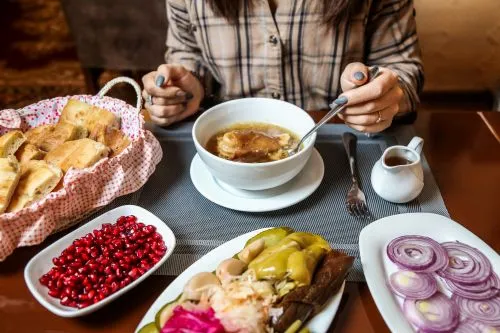
Between festive meals, declared diets, and periods of economic constraint, there is a rarely documented area: real, everyday eating. Not what surveys report, not what we display on social media, but what actually ends up on the plate on an ordinary day.
Data from consumer research and retail sales reveal a clear pattern: Romanians eat simply, repetitively, and functionally. Meals are built around 5–7 staple foods, rotated weekly. Bread, eggs, potatoes, dairy products, chicken meat, and semi-prepared foods dominate daily consumption, regardless of income or education level.
Elaborate cooking is reserved for weekends or special occasions. During the workweek, food serves a sustaining role, not an experiential one. This is precisely why “quick” products — canned foods, processed meats, ready-made meals — are not perceived as a compromise, but as a natural adaptation to time constraints.
An interesting aspect is the gap between discourse and practice. Many Romanians state that they avoid sugar, fried foods, or ultra-processed products, yet consumption data show the opposite. Not due to a lack of information, but driven by the desire for comfort and predictability.
The “normal” diet of Romanians is neither ideal nor disastrous. It is pragmatic. It reflects a fast-paced lifestyle focused on work and stability rather than nutritional performance. In the absence of extremes, food becomes a constant background — discreet, yet essential.
The true dietary snapshot is not captured on special days, but on those that are unremarkable in every way.
(Photo: Freepik)
Did you learn something new from this article?
Read also: