495

Author
infoAliment
Share on


Published on
2025 October 22
Circular Economy in the Food Industry: Reusing Processing Waste in Farms and Food Factories
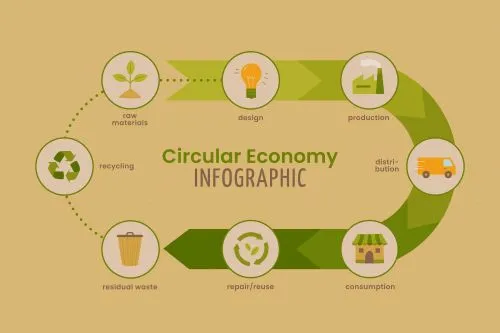
Amid growing challenges related to resources, the environment, and competitiveness, the concept of the circular economy is emerging as a strategic direction for the European agri-food sector. The main goal is to transform the traditional linear production model — “take, make, dispose” — into a closed system where waste becomes a resource.
In the food sector, the circular economy means recovering processing residues, agricultural by-products, and waste generated in farms and factories. These materials, long regarded as simple economic losses, can now be reintegrated into production cycles, reducing costs and environmental impact.
Importance for the Food Industry
Across Europe, the food industry generates tens of millions of tons of waste and by-products every year. Managing these materials not only involves high costs but also leads to greenhouse gas emissions, water consumption, and loss of fertile land. As the European Union pushes for food waste reduction and resource efficiency, reusing these waste streams has become a key priority.
For producers and processors, the circular economy offers a dual opportunity: reducing waste disposal expenses while creating new revenue streams through animal feed, biogas, compost, or secondary raw materials.
Examples of Good Practices
1. Meat Industry Slaughterhouses and processing units generate significant volumes of wastewater and by-products. Through modern filtration and bioremediation technologies, these resources can be converted into biogas or liquid fertilizers. Recovering proteins and phosphates from wastewater helps reduce costs and pollution.
2. Dairy Industry Whey, once considered a waste product, is now a valuable raw material used to produce protein concentrates, nutritional supplements, or animal feed. Other residues, such as non-compliant cheeses or recyclable packaging, can also be reintegrated into secondary production cycles.
3. Plant Processing and Beverages Peels, pulp, grape pomace, coffee grounds, and used oils are increasingly transformed into value-added products such as biofuels, organic fertilizers, natural colorants, or raw materials for the cosmetics industry. In this way, waste becomes part of a regenerative value chain.
Challenges and Limitations
The transition toward a circular economy involves several obstacles:
- Lack of clear standards for secondary raw materials and compost derived from food residues;
- High initial investment costs for treatment and reuse technologies;
- Insufficient collection and separation infrastructure at regional level;
- Low awareness among farmers and processors about the economic benefits of circular practices.
Overcoming these barriers requires close collaboration between authorities, industry, and academia, as well as a national strategy for financial and technological support.
Opportunities for Romania
Romania has significant potential to apply circular economy principles in its food sector. By using EU funds dedicated to agri-industrial modernization, farms and factories can invest in by-product recovery equipment, biogas systems, or composting facilities.
Moreover, partnerships between producers, processors, and collection centers can create integrated value chains. The concept of industrial symbiosis — where one operator’s waste becomes another’s resource — has already been successfully implemented in countries such as the Netherlands, Denmark, and France, and could be adapted in Romania as well.
Educating consumers and communicating sustainable practices transparently also contribute to building trust in local brands and strengthening the image of Romanian products on international markets.
Long-Term Benefits
Adopting the circular economy in the food industry brings direct and measurable benefits:
- Lower waste management costs;
- Creation of new income sources through by-products;
- Enhanced brand reputation and compliance with EU standards;
- Reduced carbon footprint and better resource protection.
Conclusion
The circular economy is not merely an ecological ideal — it is a smart economic strategy for a competitive and sustainable food industry. For Romania, it can become a regional differentiator, turning current vulnerabilities — losses, waste, inefficiency — into renewable resources and added value.
The future of the food industry will belong to those who combine innovation with responsibility, proving that profit and sustainability can truly go hand in hand.
(Photo: Freepik)
Did you learn something new from this article?
Read also: