631

Author
infoAliment
Share on


Published on
2026 April 14
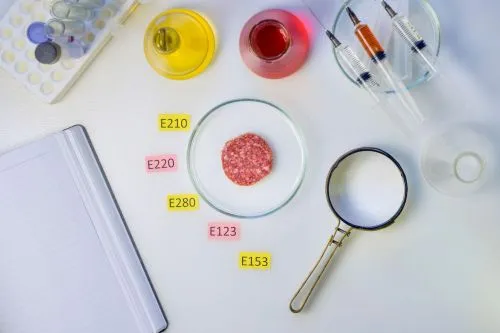
It is not what you see on your plate that defines your diet, but what you do not see. Behind clean labels and “known” ingredients, there is a category of invisible elements that enter the body daily: microplastics, nanoparticles, and compounds resulting from processing.
Recent studies show that microplastics have been identified in bottled water, salt, honey, and even in animal-based products. These originate from packaging, industrial processes, and widespread environmental pollution. At the same time, the food industry uses nanoparticles to improve texture, color, or shelf life—for example, titanium dioxide or silica in nano form.
The issue is not necessarily their presence, but the lack of transparency. Labels do not always reflect particle size or how these substances interact with the human body. In the case of nanoparticles, their biological behavior may differ from that of the conventional form of the substance.
Although European authorities, including the European Food Safety Authority, assess the safety of additives, research is still ongoing, and long-term effects remain partially unknown.
For consumers, the solution is not panic, but awareness. Reducing ultra-processed foods, choosing products with shorter supply chains, and limiting plastic packaging can help decrease exposure.
In an era where food is becoming increasingly technologized, the real challenge is not what we eat, but how well we understand what we do not see.
(Photo: AI GENERATED)
Did you learn something new from this article?
Read also: