604

Author
infoAliment
Share on


Published on
2026 April 16
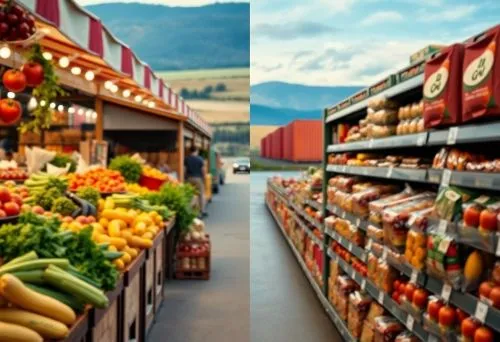
In a globalized food market, the origin of products is becoming increasingly difficult to trace. Shelves are full, yet a large share of the food consumed daily comes from outside the country. The difference is not only geographical, but economic.
A simple test can provide a relevant picture: how many of the products you consume daily are locally produced? How often do you check the country-of-origin label? Do you choose based on price or provenance? The answers outline a dietary profile: local, mixed, or import-dependent.
European data show that food supply chains are becoming increasingly interconnected, while dependence on imports is rising in certain segments, particularly for processed products. At the same time, local production exists, but is not always fully reflected in final consumption.
This dependence is not immediately visible. However, it is reflected in the trade balance, price stability, and the ability of the food system to respond to crises.
For the consumer, the choice remains individual, but the effect is collective. Every product selected indirectly supports a particular economic model: local or global.
The test does not provide a right or wrong answer, but a perspective. In a context where food security is becoming increasingly important, understanding one’s own consumption behavior is the first step.
(Photo: AI GENERATED)
Did you learn something new from this article?
Read also: