296

Author
infoAliment
Share on


Published on
2026 February 02
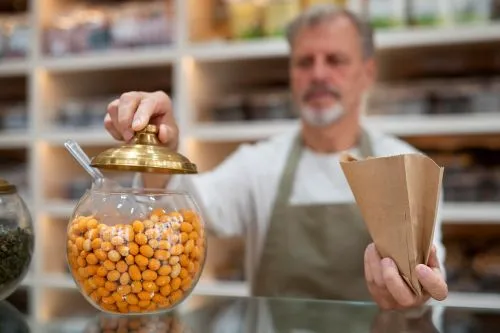
Traditional products are valued for their taste, authenticity, and connection to local identity. However, many of them disappear quickly from supermarket shelves or fail to enter modern retail altogether. The issue is not quality, but the mismatch between traditional production methods and the requirements of commercial retail chains.
The first breaking point is volume. Modern retail operates on large, predictable flows. A traditional producer, working seasonally or artisanally, cannot ensure consistent quantities for dozens or hundreds of stores. Lack of volume is not a flaw, but it becomes a logistical barrier.
The second factor is product consistency. Supermarkets require the same taste, texture, and appearance in every batch. In traditional production, natural variations are common and locally accepted, but they are difficult to integrate into a standardized system.
Price represents another major challenge. Production costs for traditional products are generally higher: local raw materials, manual labor, and lower yields. In retail, where prices are directly compared with industrial alternatives, margins become insufficient for both parties.
Lastly, logistics plays a decisive role. Modern retail requires scheduled deliveries, standardized packaging, compliant labeling, and computerized systems. Many traditional producers lack the infrastructure needed to meet these requirements, even when the product itself is excellent.
The failure, therefore, is not one of taste or authenticity, but of economic compatibility. Traditional products perform best in local markets, specialty shops, direct sales, or short supply chains.
Modern retail is not the enemy of tradition, but neither is it its natural environment. Success emerges only when production partially adapts to commercial requirements or when alternative channels are created that capitalize on uniqueness rather than uniformity.
(Photo: Freepik)
Did you learn something new from this article?
Read also: