453

Author
infoAliment
Share on


Published on
2025 December 15
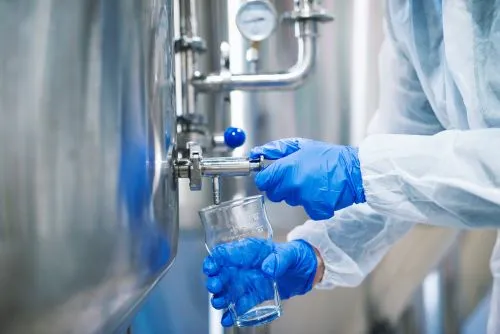
The food industry is one of the largest consumers of potable water within the industrial sector. Paradoxically, a large share of this water never reaches the final product, but is instead used for washing, cooling, heat transfer, or technological cleaning. In the context of European pressure on water resources, a clear direction is emerging: the strict separation of potable water from technological water and the gradual transition to internally regenerated water.
What regenerated technological water is Regenerated technological water is water resulting from internal factory processes—condensate from thermal processes, cooling water, washing water—that is treated and reused in applications where it does not come into direct contact with food. It is not intended for human consumption, but it can meet all technical safety and hygiene requirements.
Where potable water is unnecessarily consumed In many factories, potable water is used for:
- washing floors and equipment,
- cooling systems,
- heat transfer,
- washing crates and containers,
- auxiliary steam generation.
In these cases, the requirement for potability is not technologically justified.
How water regeneration works in factories Modern treatment systems include:
- mechanical and biological filtration,
- reverse osmosis or ultrafiltration,
- UV or ozone disinfection,
- continuous parameter monitoring.
The regenerated water is then directed into separate circuits, clearly marked and strictly controlled.
Economic benefits Factories that implement these systems can reduce:
- potable water consumption by 40–70%,
- wastewater discharge costs,
- dependence on public supply networks,
- risks associated with water restrictions.
Especially in the meat, beverage, and dairy industries, investment payback can occur within 2–4 years.
European regulations allow the reuse of treated water in technological applications, provided there is strict separation from the food flow and rigorous control. HACCP thus extends from the product itself to resource management.
The future of the food industry is not only about safe products, but also about intelligently managed resources. The transition from potable water to regenerated technological water is one of the most important structural transformations that will define competitive factories in the coming decade.
(Photo: Freepik)
Did you learn something new from this article?
Read also: