1112

Author
infoAliment
Share on


Published on
2023 October 10
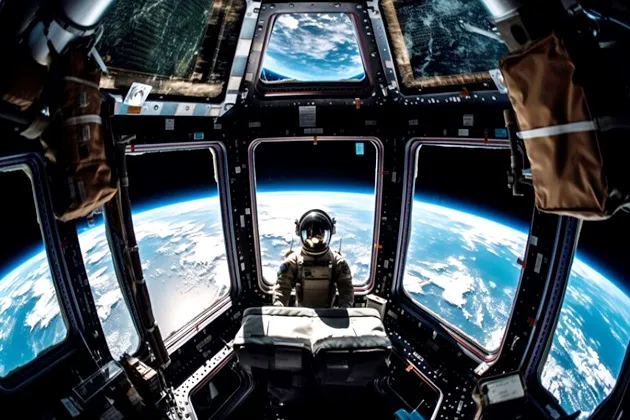
As reported by FoodNavigator, in August 2023, scientists launched a study exploring controlled environment agriculture in space (SpaCEA), an extension of the existing method of terrestrial controlled environment agriculture (CEA). Published in the journal Nature Food, researchers found that SpaCEA offers ways to improve the sustainability of CEA on Earth.
Seeking Space-Like Solutions
In the study, researchers anticipated that CEA would have an increasing presence in food production due to its significant role in food growth. However, since the production method requires substantial amounts of energy and resources and is not profitable, researchers suggest that SpaCEA provides improvements in sustainability.
The aim of exploring SpaCEA is to build CEA systems that are inherently circular. SpaCEA builds upon CEA by making modifications in the design and optimization of agricultural methods.
By using life cycle analysis tools to optimize the use of natural or electric light, energy, nutrients, and infrastructure in a CEA or SpaCEA system, producers can create more circular food production systems.
These tools can also help guide research and development (R&D) in food production subsystems, leading to positive environmental benefits, according to the scientists in the study.
By using space to showcase CEA food cultivation technologies, SpaCEA can improve the terrestrial CEA's perception of global food production efforts, the researchers argued. Placing significant emphasis on the development of SpaCEA is an efficient way to address existing challenges related to resources and energy associated with traditional CEA.
The study's conclusions, which state that SpaCEA must have strong resource efficiency and circularity in design, can provide production opportunities for global producers.
Challenges
There are challenges for producers and the food industry in general to adopt SpaCEA. However, there are significant similarities between SpaCEA and more "traditional" CEA. "If you can grow plants in a Canadian snowbank, you're pretty far along in being able to grow plants on the moon," said Dr. Matthew Bamsey, Senior Manager of Advanced Concepts and Future Missions at the Canadian Space Agency for FoodNavigator.
Space investigations need to have applications that bring benefits to Canadians' everyday lives, Dr. Bamsey said. "Learning how to produce food in space will bring benefits to food production on Earth, especially in remote and harsh environments like Canada's North," Dr. Bamsey added.
For instance, the Canadian Space Agency (CSA) is working with other organizations and the community in Gjoa Haven as part of the Naurvik Initiative to develop a community-led hydroponic food production system. Using almost exclusively renewable energy sources like wind and solar, the project aims to find sustainable solutions for growing fresh food year-round.
CSA, Impact Canada, and NASA have joined forces to launch the Deep Space Food Challenge. They invited participants to submit their best ideas for applying and developing ways to feed future astronauts, considering how their solutions can provide benefits on Earth. The agency is now in Phase 3 of this challenge, with the four finalist teams developing prototypes of their systems.
Continued collaboration between the space and agricultural technology sectors to enhance idea generation opportunities at this intersection of food production. "The challenge of designing things for space can stimulate new ideas and bring new players into the CEA field," says Dr. Bamsey.
Lessons from Space
SpaCEA advances exploration beyond traditional terrestrial CEA. "For space, everything must be designed to be low mass, low volume, low power, and very reliable," Dr. Bamsey said for this publication. These conditions put engineers and scientists in a different mindset.
Therefore, researchers can stimulate new ideas that lead to concepts that maximize the number of green items, such as plants and produced foods, for the minimal amount of input resources, such as energy and consumables.
"Such efficient and reliable systems will be essential as astronaut missions become longer and as people explore farther from Earth, where resupply becomes even more challenging," says Dr. Bamsey.
Continued work in SpaCE builds upon existing findings. In 2016, the European Commission published the final report of the Controlled Environment Agriculture Development for Space and Earth (CEADSE) project. The CEADSE project was a European Union (EU) Marie-Curie grant that provided funding for postdoctoral research.
Dr. Bamsey conducted his research at the German Aerospace Center (DLR). The CEADSE project and Dr. Bamsey's research focused on developing a greenhouse at the German Neumayer III Station in Antarctica to test technologies that could one day provide food for the future.
During one of his early student internships at the Canadian Space Agency (CSA), Dr. Bamsey worked on the Arthur Clarke Mars Greenhouse project. CSA worked with other partners to operate a greenhouse on Devon Island in the Canadian Arctic.
Since then, CSA and the German Aerospace Center have held regular discussions on future opportunities in SpaCEA and to continue work in food production.
(Source: 'Space controlled environment agriculture offers pathways to improve the sustainability of controlled environmental agriculture on Earth’ Authors: H. C. Wright, L. Fountain, A. Moschopoulos, A. J. Ryan, T. J. Daniell, D. C. Cullen, B. Shaughnessy & D. D. Cameron)